Article Encoded By
Administrator
Tech Tuesday | Special Edition: The Maker’s Manifesto
For years, the "Digital Revolution" in education was defined by a simple, expensive gesture: handing a tablet to every learner. But in the STEAMELA framework, we recognize that true empowerment isn't found in consuming technology—it’s found in mastering it.
Smart learning isn't just knowing how to swipe; it’s knowing how to manufacture.
I. The Science of the Silicon
A tablet isn't a "magic box"; it’s a masterclass in Science and Mathematics. When learners study the chemistry of lithium-ion batteries and the physics of touch-sensitive glass, they aren't just students—they are junior scientists.
- The Action: Move from user to analyst. Deconstruct the "black box" of modern tech to understand the raw elements and energy equations required to make it work.
II. Engineering the Hardware
Handing out tablets creates "digital consumers." Teaching learners to Engineer them creates "digital creators."
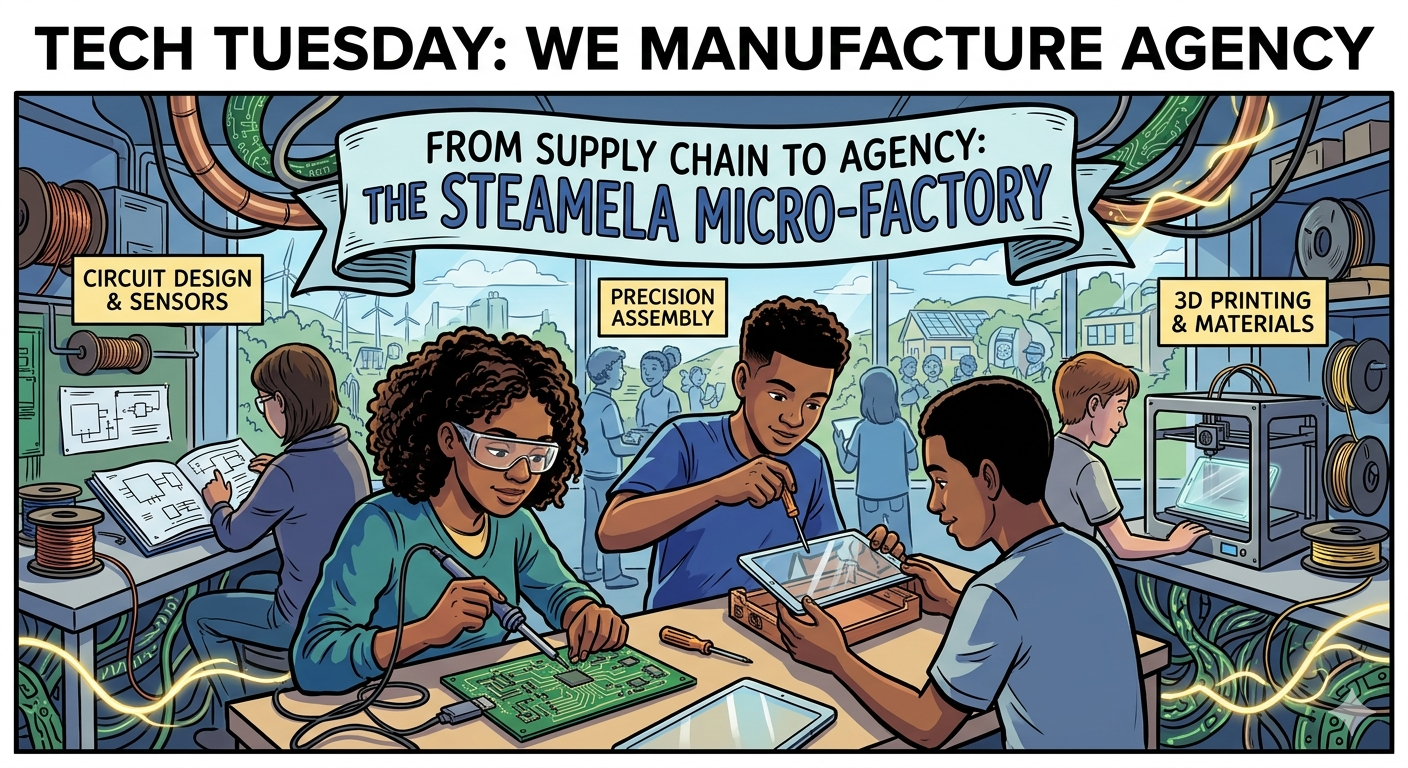
- The Structure: Smart learning involves setting up "Micro-Factories" in schools. Using Mathematics to design circuit boards and Technology like 3D printers to create casings, learners build the very tools they use. This is the ultimate Engineering challenge: making something functional, durable, and repairable.
III. The Literature of the Supply Chain
Manufacturing isn't just about parts; it’s about people. This is where Literature and the Arts provide the ethical compass.
- The Literature: We must teach the "Story of the Tablet." Where did the cobalt come from? What is the human cost of the supply chain? Reading the global narrative of production allows learners to design more ethical, sustainable tech.
- The Arts: Design thinking is an art form. The aesthetics and user interface (UI) of a self-made device are reflections of the creator's cultural identity and artistic vision.
IV. Praxis: From Assembly to Agency
This is the Action. When a learner solders their first connection or codes their first custom OS for a device they built themselves, they move from a state of dependency to a state of Agency.
- The Real-World Application: "Smart Learning" is a school where the graduating class leaves behind a legacy of hardware they manufactured for the incoming class. That is Praxis—the theory of STEAMELA turned into a tangible, self-sustaining community resource.
The Manufacturing Manifesto
Don't just give them the world on a screen; teach them how to build the screen. The tablet is a tool, but the Action of creating it is the education.
Are we ready to stop buying the future and start manufacturing it?
End of Dispatch. Transmission Secure.